

| Key Insight | Explanation |
|---|---|
| Withdrawal starts fast | Nicotine cravings can begin within 30–60 minutes of your last dose, with peak intensity typically hitting at 48–72 hours. |
| The hardest window is days 2–3 | Physical symptoms — irritability, headaches, difficulty concentrating — peak around 48–72 hours before gradually easing. |
| Most symptoms resolve in 2–4 weeks | The acute physical withdrawal phase clears for most people within 2–4 weeks, though psychological cravings can linger longer. |
| Nicotine replacement helps | Tobacco-free nicotine pouches and other NRT (nicotine replacement therapy) options can ease the transition by maintaining controlled nicotine intake. |
| Psychological cravings outlast physical ones | Habit-linked cravings tied to routines (morning coffee, after meals) can persist for weeks or months after physical withdrawal ends. |
| Everyone's timeline differs | Factors like daily nicotine intake, years of use, and individual metabolism all affect how quickly and intensely withdrawal unfolds. |
The nicotine withdrawal timeline is one of the most searched health questions among adults trying to quit smoking or switch to tobacco-free alternatives — and for good reason. Knowing exactly what's coming, and when, is the difference between white-knuckling through days two and three and understanding that the discomfort is temporary, predictable, and manageable. Nicotine withdrawal is the set of physical and psychological symptoms that occur when a regular nicotine user reduces or stops their intake. Symptoms typically begin within hours of the last dose, peak between 48 and 72 hours, and largely resolve within two to four weeks, though habit-linked cravings can persist longer. This guide walks you through each phase, what drives the symptoms, and how tobacco-free alternatives like nicotine pouches fit into a practical transition strategy.
What Is Nicotine Withdrawal?
Nicotine withdrawal is the cluster of physical and psychological symptoms that arise when the brain and body are deprived of nicotine after a period of regular use. It is a recognized clinical condition, classified under substance withdrawal in the DSM-5 (Diagnostic and Statistical Manual of Mental Disorders, Fifth Edition), the standard diagnostic framework used by clinicians worldwide. This is particularly relevant for nicotine withdrawal timeline.
Why Withdrawal Happens at All
Nicotine is a highly addictive alkaloid that binds to nicotinic acetylcholine receptors (nAChRs) in the brain, triggering the release of dopamine — the neurotransmitter associated with reward and pleasure [1]. With repeated exposure, the brain upregulates (increases) the number of these receptors and becomes dependent on nicotine to maintain normal dopamine signaling. Remove the nicotine, and that signaling system temporarily underperforms — producing the irritability, anxiety, and low mood that characterize withdrawal.
According to the American Lung Association, nicotine reaches the brain within 10 seconds of inhalation, which is part of why smoked tobacco creates such strong dependence — the rapid delivery reinforces the habit loop far more efficiently than slower-release formats [2].
Who Experiences Withdrawal?
Not every nicotine user experiences severe withdrawal. Severity depends on several factors:
- Daily nicotine intake: Heavier users (more than 20 cigarettes per day, or equivalent) typically experience more intense symptoms.
- Duration of use: Years of regular use mean more deeply entrenched receptor upregulation.
- Individual metabolism: How quickly your body processes nicotine (governed largely by the CYP2A6 enzyme) affects both dependence level and withdrawal intensity.
- Delivery method: Smoked tobacco creates faster, stronger reinforcement than oral formats like pouches or gum, generally producing stronger withdrawal when stopped abruptly.
- Psychological factors: Stress levels, mental health history, and the strength of habit-linked triggers all shape the experience.
Research published in PMC/NIH confirms that nicotine dependence involves both physical tolerance and psychological conditioning — meaning the full withdrawal picture is never purely biochemical [3]. When considering nicotine withdrawal timeline, this point stands out.
The Nicotine Withdrawal Timeline: Hour by Hour
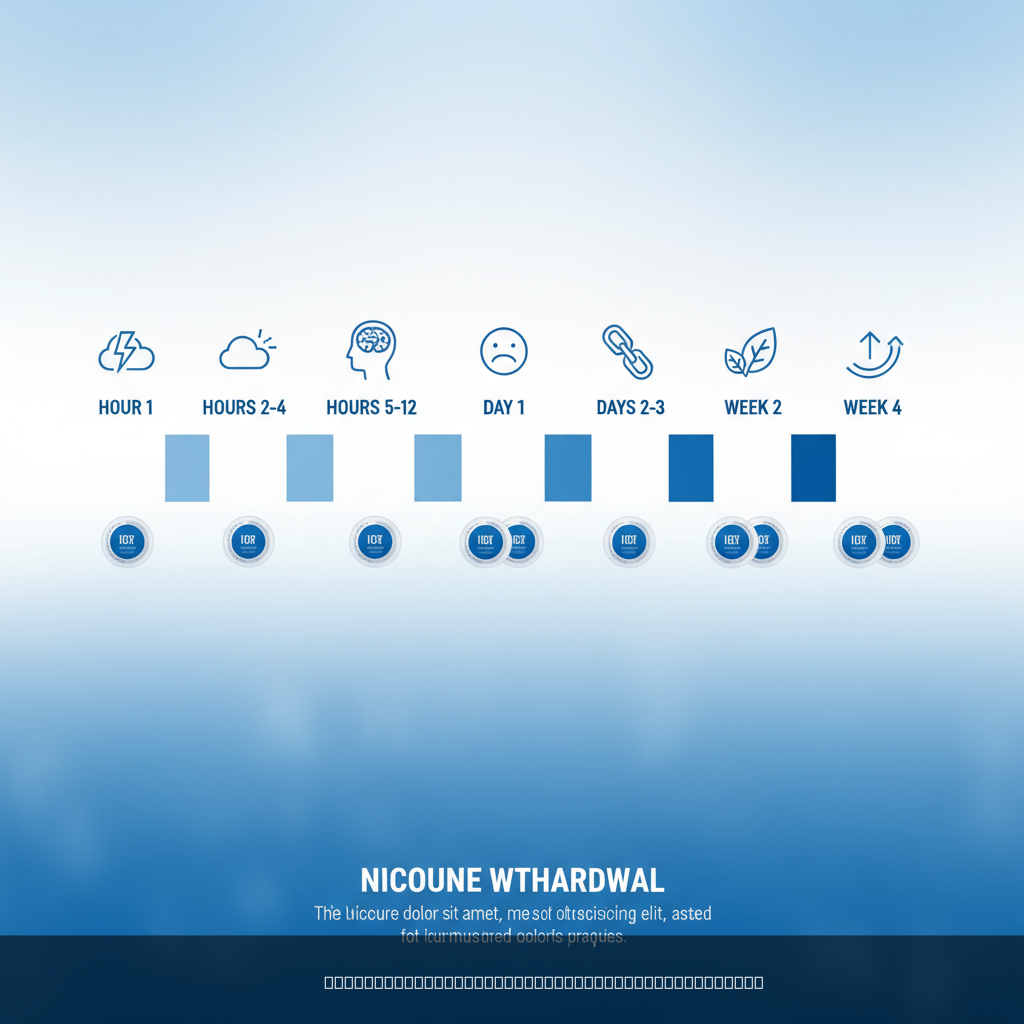
The nicotine withdrawal timeline follows a broadly predictable arc: symptoms begin within 30–60 minutes for heavy users, intensify over the first 48–72 hours, then gradually ease over two to four weeks.
Phase 1: The First 24 Hours
This is when the body first registers the absence of nicotine. Blood nicotine levels drop sharply, and the brain starts signaling that something is missing. Here's what typically happens:
- 30–60 minutes: First cravings appear in heavy smokers. Mild restlessness begins.
- 2–4 hours: Cravings intensify. Irritability and difficulty concentrating become noticeable.
- 8–12 hours: Carbon monoxide levels in the blood normalize (relevant for smokers). Oxygen delivery to tissues improves, but cravings are strong.
- 24 hours: Anxiety levels often peak during this window. Some users report headaches and increased appetite. Heart rate begins to normalize.
Pro Tip: If you're switching from cigarettes to nicotine pouches rather than quitting cold turkey, this first 24-hour window is far more manageable. A 6mg–8mg pouch from brands like ZYN or VELO delivers controlled nicotine without the combustion, keeping cravings in check while your body adjusts to the new delivery format.
Phase 2: Days 2–7 (The Peak)
This is the hardest stretch for most people. Physical symptoms reach their maximum intensity around 48–72 hours, then begin a slow decline.
| Time Point | Primary Symptoms | Intensity (1–10) |
|---|---|---|
| 30–60 min | First cravings, mild restlessness | 3–4 |
| 24 hours | Anxiety, irritability, headaches, increased appetite | 5–6 |
| 48–72 hours | Peak cravings, insomnia, difficulty concentrating, mood swings | 7–9 |
| Days 4–7 | Symptoms begin easing; fatigue, occasional cravings | 4–6 |
| Weeks 2–4 | Physical symptoms largely resolved; habit-linked cravings persist | 2–4 |
| Month 1+ | Psychological cravings triggered by routines, stress, social settings | 1–3 |
According to Medical News Today, the physical symptoms of nicotine withdrawal typically resolve within 2–4 weeks, but the psychological component — cravings tied to behavioral cues — can persist for months in some individuals [4].
Symptoms by Stage: What You'll Actually Feel
Nicotine withdrawal symptoms fall into two broad categories: physical (driven by neurochemical rebalancing) and psychological (driven by conditioned habit loops). Both are real. Neither lasts forever. For those exploring nicotine withdrawal timeline, this matters.

Physical Symptoms
These are the symptoms most directly tied to neurochemical changes. They're uncomfortable, but they're also the fastest to resolve.
- Cravings: The most universal symptom. Individual cravings typically last 3–5 minutes — short but intense.
- Headaches: Caused by changes in cerebral blood flow as the body adjusts without nicotine's vasoconstrictive effects.
- Increased appetite and weight gain: Nicotine suppresses appetite by raising metabolic rate. Removal reverses this. The American Heart Association notes that average post-cessation weight gain is around 4–5 kg, though this varies widely [5].
- Insomnia and disrupted sleep: Nicotine affects sleep architecture; its removal temporarily disrupts normal sleep patterns.
- Constipation: Nicotine stimulates bowel activity; withdrawal often causes temporary digestive sluggishness.
- Sweating and dizziness: Less common but reported, particularly in the first 48–72 hours.
Psychological Symptoms
These are often harder to manage than physical symptoms because they're tied to deeply ingrained behavioral patterns.
- Irritability and mood swings: Dopamine disruption directly affects emotional regulation. This is the symptom most often reported by people around the person quitting, not just the quitter themselves.
- Anxiety: Nicotine has anxiolytic (anxiety-reducing) effects for regular users. Removing it temporarily increases baseline anxiety.
- Difficulty concentrating: Nicotine enhances acetylcholine activity, which supports attention and focus. Withdrawal temporarily impairs this.
- Depression or low mood: Dopamine depletion during early withdrawal can produce a flat, low-energy state. This typically resolves within two weeks.
- Habit-linked cravings: The strongest long-term challenge. Morning coffee, after-meal cigarettes, stress at work — these contextual triggers can fire cravings weeks or months after physical withdrawal ends.
Pro Tip: Individual cravings rarely last more than 5 minutes. When a craving hits, delay your response by 5 minutes — drink water, change your environment, or use a nicotine pouch to satisfy the oral component. Most cravings pass before the 5-minute mark is up.
The CDC recognizes nicotine pouches as a tobacco-free oral nicotine format that some users adopt during cessation transitions. As of 2026, their role in step-down strategies — using progressively lower-strength pouches to taper nicotine intake — is an increasingly discussed approach among harm-reduction advocates [6].
Managing Withdrawal in 2026: Best Practices
Managing nicotine withdrawal effectively means addressing both the physical and psychological dimensions simultaneously. No single strategy works for everyone, but the evidence-based approaches below have the strongest track records as of 2026. This directly impacts nicotine withdrawal timeline outcomes.
Nicotine Replacement and Step-Down Strategies
NRT (nicotine replacement therapy) is the most clinically validated approach to managing withdrawal. The core principle is simple: maintain enough nicotine to prevent severe symptoms while removing the harmful delivery method (combustion, tobacco leaf). Options include patches, gum, lozenges, inhalers, and tobacco-free nicotine pouches.
A step-down strategy using nicotine pouches works like this:
- Start at your current equivalent strength. If you smoke 15–20 cigarettes per day, begin with a 6mg–8mg pouch to match your intake without overshooting.
- Stabilize for 1–2 weeks. Don't try to reduce strength during the first two weeks. Let the physical withdrawal from combustion settle first.
- Drop one strength level every 2–4 weeks. Move from 8mg to 6mg, then 4mg, then 2mg. Gradual reduction keeps cravings manageable.
- Use the lowest effective strength for as long as needed. There's no prize for rushing the process.
- Address habit-linked triggers separately. The step-down handles the physical side; behavioral strategies handle the psychological side.
At DarePouch, we've found that users who start with a clearly matched strength — rather than jumping to the lowest available option — have a much smoother transition. Brands like ZYN (available in 3mg and 6mg), VELO (4mg and 6mg), and Nordic Spirit (6mg and 9mg) cover the lower end of the strength range well for this purpose.
Behavioral and Lifestyle Strategies
Physical management is only half the equation. Addressing the psychological and behavioral side is equally important. This is particularly relevant for nicotine withdrawal timeline.
- Identify your triggers: Map out the specific situations, times of day, and emotional states that produce cravings. Awareness is the first step to interrupting the habit loop.
- Replace the ritual, not just the nicotine: Much of the craving is about the routine — the break, the hand-to-mouth action, the pause. Substituting a nicotine pouch preserves the ritual without the smoke.
- Exercise: Physical activity increases dopamine and serotonin, partially compensating for the neurochemical gap left by nicotine withdrawal. Even a 20-minute walk helps.
- Sleep hygiene: Prioritize sleep during the first two weeks. Withdrawal-related insomnia is real, but fatigue makes every other symptom worse.
- Avoid high-risk social situations early on: Social smoking triggers are among the most powerful. The first two weeks aren't the time to test your resolve at a party.
Pro Tip: If you're using nicotine pouches as part of a step-down plan, store them properly. Heat and humidity degrade the nicotine content and flavor over time. DarePouch stores all products in climate-controlled fridge conditions before dispatch — so the strength on the label is the strength you actually get, which matters when you're managing a precise taper.
Common Mistakes That Make Withdrawal Harder
Most withdrawal failures aren't about willpower. They're about avoidable mistakes that stack the deck against you. Recognizing these patterns in advance is half the battle.
Mistake 1: Quitting Cold Turkey Without a Plan
Cold turkey works for some people — research suggests roughly 3–5% of unassisted quit attempts succeed long-term. For the majority, abrupt cessation without any NRT or behavioral support dramatically increases the intensity of the 48–72 hour peak. The American Lung Association consistently recommends combining behavioral support with NRT for the best outcomes [2].
Mistake 2: Choosing the Wrong NRT Strength
This is the most common mistake in practice. Starting too low means cravings aren't adequately managed and the risk of relapse spikes. Starting too high causes nausea, dizziness, and a generally unpleasant experience that puts people off NRT entirely.
A common mistake is picking a 2mg or 3mg nicotine pouch when you're coming off 20 cigarettes a day. Your body is used to far more. The discomfort isn't a sign that pouches don't work — it's a sign the dose is wrong. Match the strength to your current intake first, then taper. When considering nicotine withdrawal timeline, this point stands out.
- Light smokers (under 10 cigarettes/day): Start at 3mg–4mg pouches.
- Moderate smokers (10–20 cigarettes/day): Start at 6mg–8mg pouches.
- Heavy smokers (20+ cigarettes/day): Start at 8mg–12mg pouches.
Mistake 3: Treating Psychological Cravings as Physical Ones
By week three, most physical withdrawal is behind you. But cravings still hit. Many people interpret this as evidence that they're "still addicted" and panic. In reality, these are habit-linked cravings — conditioned responses to environmental triggers, not biochemical need. They're real, but they respond to behavioral strategies, not more nicotine.
One pitfall to watch for: using a high-strength pouch to manage a habit-linked craving in week three actually reinforces the nicotine-seeking behavior rather than extinguishing it. If you're past the acute phase, consider whether you need a lower-strength option or a non-nicotine distraction instead.
The DrugBank profile for nicotine notes that nicotine's reinforcing properties involve both pharmacological and conditioned learning components — which is precisely why behavioral intervention alongside NRT consistently outperforms either approach alone [7].
Sources & References
- FDA, "Nicotine Is Why Tobacco Products Are Addictive"
- American Lung Association, "Nicotine"
- PMC/NIH, "Harmful Effects of Nicotine"
- Medical News Today, "Nicotine: Facts, Effects, and Dependency"
- American Heart Association, "How Smoking and Nicotine Damage Your Body"
- CDC, "Nicotine Pouches"
- DrugBank, "Nicotine: Uses, Interactions, Mechanism of Action"
- Wikipedia, "Nicotine"
- Alcohol and Drug Foundation, "Tobacco"
Frequently Asked Questions
1. How long does the nicotine withdrawal timeline last?
The nicotine withdrawal timeline varies by individual, but for most people the acute physical phase lasts 2–4 weeks. The hardest window is the first 48–72 hours, when symptoms like irritability, headaches, and intense cravings peak. After week two, physical symptoms largely subside. Psychological cravings tied to behavioral habits can persist for several weeks or months beyond that, particularly in response to situational triggers like stress, meals, or social settings.
2. What are the worst days of nicotine withdrawal?
Days two and three are almost universally reported as the most intense. By 48–72 hours, blood nicotine levels have dropped to near zero and the brain's dopamine system is at its most disrupted. Symptoms during this window typically include severe cravings, irritability, difficulty sleeping, trouble concentrating, and sometimes headaches or nausea. The good news: after the 72-hour mark, most people notice a gradual but consistent improvement each day. For those exploring nicotine withdrawal timeline, this matters.
3. Does nicotine interact with ivermectin?
Preclinical research suggests ivermectin may interact with nicotine's effects on the brain. Ivermectin acts on glutamate-gated chloride channels and GABA receptors, which overlap with some of the neurological pathways involved in nicotine dependence. Animal studies have indicated that ivermectin may reduce nicotine-seeking behavior and ease the reinstatement of nicotine cravings. However, this research is preliminary and conducted in animal models — there is currently no clinical evidence supporting ivermectin as a treatment for nicotine withdrawal in humans. Do not use ivermectin for this purpose without medical supervision.
4. Can nicotine pouches help with withdrawal from cigarettes?
Yes, tobacco-free nicotine pouches can be an effective tool for managing cigarette withdrawal. They deliver nicotine without combustion or tobacco leaf, addressing the physical dependence while eliminating smoke, tar, and carbon monoxide. The key is matching the pouch strength to your current intake — starting too low leaves cravings unmanaged, while starting too high causes discomfort. A 6mg–8mg pouch is a reasonable starting point for moderate smokers. The CDC acknowledges nicotine pouches as a tobacco-free oral nicotine format used by adults seeking alternatives.
5. Is nicotine withdrawal dangerous?
Nicotine withdrawal is uncomfortable but not medically dangerous for most people. Unlike alcohol or benzodiazepine withdrawal, it does not carry a risk of seizures or life-threatening complications. The primary risks are psychological: the discomfort of withdrawal is a leading driver of relapse. People with pre-existing mental health conditions — particularly depression or anxiety disorders — may experience more pronounced mood-related symptoms and should consider speaking with a healthcare provider before attempting cessation. Results vary based on individual health history.
6. How does nicotine withdrawal differ between smokers and pouch users?
Smokers generally experience more intense withdrawal than pouch users when stopping, largely because smoked nicotine reaches the brain faster (within 10 seconds), creating stronger reinforcement and deeper dependence. Oral nicotine formats like pouches have a slower absorption curve, which typically means a somewhat less acute withdrawal experience when stopped. That said, heavy pouch users at high strengths (20mg+) can still experience significant withdrawal — the delivery method matters, but total nicotine intake and duration of use are equally important factors.

The Bottom Line
The nicotine withdrawal timeline is predictable, manageable, and finite. The first 72 hours are the hardest. By week two, the physical symptoms have largely cleared. By week four, most people are through the acute phase entirely — though habit-linked cravings require ongoing behavioral awareness.
The biggest variable isn't willpower. It's strategy. Matching your NRT strength to your actual intake, addressing behavioral triggers separately, and understanding that each craving lasts only minutes — these practical adjustments make a measurable difference in outcomes.
If you're switching from cigarettes or vaping to tobacco-free nicotine pouches, the nicotine withdrawal timeline looks very different from cold turkey. Brands like ZYN, VELO, Nordic Spirit, and Killa offer a range of strengths from 3mg to 20mg+ that let you step down gradually rather than abruptly. DarePouch stocks 500+ products across all three pouch categories — nicotine, energy, and CBD — with same-day dispatch, climate-controlled freshness guarantees, and expert strength guides to help you find exactly the right product for where you are in the process. Start lower than you think you need, taper methodically, and give your brain the time it needs to rebalance.

Recommended Articles
Explore more from our content library:


