

| Key Insight | Explanation |
|---|---|
| What they are | Functional energy pouches are small, tobacco-free oral sachets delivering caffeine and other active ingredients through the gum lining — no liquid, no smoke, no nicotine required. |
| How fast they work | Most users feel effects within 10-20 minutes, faster than a cup of coffee because absorption bypasses the digestive system. |
| Caffeine range | Doses typically range from 40mg to 100mg per pouch — equivalent to roughly half a cup to a full cup of coffee. |
| Key functional ingredients | Beyond caffeine, leading products include L-theanine, B-vitamins, taurine, adaptogens, and nootropics for cleaner, more sustained energy. |
| Who they're for | Adults seeking a sugar-free, portable, discreet energy boost without the crash associated with traditional energy drinks. |
| Regulatory status (2026) | Classified as food supplements in most EU markets; nicotine-free status means fewer restrictions than nicotine pouches in most European countries. |
Functional energy pouches are small, tobacco-free oral sachets that deliver caffeine and other active compounds directly through the mucous membranes of the gum, providing a fast, clean energy boost without sugar, liquid, or nicotine. They sit in a growing product category that blends the discreet format of nicotine pouches with the performance-focused ingredient stacks found in energy drinks. This guide covers exactly how they work, what's inside them, who should use them, and how to pick the right one for your needs.
What Are Functional Energy Pouches?
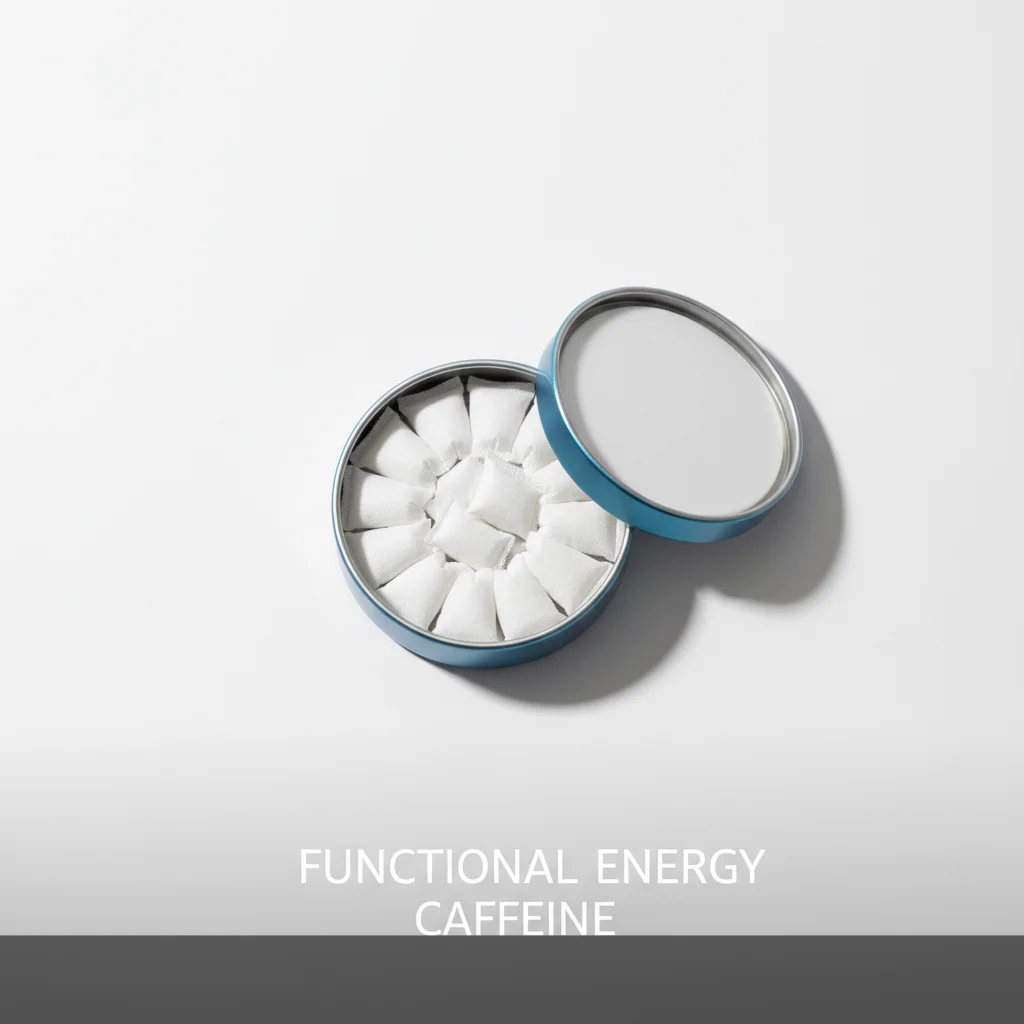
Functional energy pouches are nicotine-free, tobacco-free oral pouches containing caffeine and supporting active ingredients, designed to deliver a measurable energy and focus effect through the gum lining. They look identical to nicotine pouches — small white sachets packed into round, snap-lid tins — but contain zero nicotine and zero tobacco.
The Category Defined
The term "functional" here is specific. It refers to pouches formulated with ingredients that serve a physiological purpose beyond flavoring — primarily caffeine, but increasingly L-theanine (an amino acid that promotes calm focus), B-vitamins, taurine, and adaptogens like ashwagandha or rhodiola. According to Nectr Energy's analysis of the category, functional pouches now deliver caffeine, nootropics, vitamins, and adaptogens — and the segment is growing rapidly as consumers look for stimulation without liquid calories or smoke [1].
As of 2026, the most widely available functional energy pouches on the European market fall into three sub-types:
- Caffeine-only pouches: Simple, single-ingredient options typically containing 40mg to 100mg of caffeine per pouch. XQS, for example, offers 100mg caffeine per pouch with zero nicotine [2].
- Caffeine + L-theanine pouches: The most popular format for professionals and students. The 2:1 ratio of caffeine to L-theanine is a well-established nootropic stack that smooths out the jittery edge of caffeine alone.
- Nootropic stacks: Advanced formulations combining caffeine with adaptogens, B-vitamins, and cognitive enhancers like lion's mane or bacopa monnieri. These are aimed at users who want sustained mental performance rather than a quick spike.
Why the Format Matters
The pouch format itself is part of the value proposition. You place it between your upper lip and gum, leave it for 15-30 minutes, and discard it. No preparation, no drink to finish, no sugar crash. That's a meaningful practical advantage over energy drinks in situations where you can't carry a can — a meeting, a gym session, or a long drive.
Industry analysts note that the global functional supplement market is expanding sharply, driven by demand for portable, sugar-free delivery formats. The BSCG (Banned Substances Control Group) has identified energy pouches as a novel oral delivery system within the supplement market, noting their potential for both performance use and compliance risk in competitive sports contexts [3].
Pro Tip: If you're new to functional energy pouches, start with a product containing 50mg caffeine or less. Higher-dose options (80-100mg) are designed for users who already have a high caffeine tolerance. Jumping straight to 100mg per pouch — especially if you're also drinking coffee — is a reliable way to feel anxious and jittery rather than focused.
How Functional Energy Pouches Work
this approach work through buccal absorption — active ingredients pass through the thin mucous membrane lining the inside of your cheek and gum, entering the bloodstream directly without passing through the digestive system first.
The Absorption Mechanism
This is the core reason why pouches feel faster than a cup of coffee or an energy drink. When you drink caffeine, it travels through your stomach and small intestine before entering systemic circulation. That process takes 30-60 minutes for peak plasma concentration. Buccal absorption, by contrast, bypasses this route entirely.
In practice, most users report noticing effects from a caffeine pouch within 10-20 minutes. The onset is smoother because the dose enters the bloodstream more gradually than a bolus of liquid caffeine. Research published in PMC (PubMed Central) on energy drink ingredient absorption confirms that delivery route significantly affects both onset speed and peak effect magnitude of stimulant compounds [4].
What Happens Step by Step
- Placement: You tuck the pouch between your upper lip and gum. Some users prefer the lower lip — both work, though upper placement tends to produce slightly faster absorption for most people.
- Moisture activation: Saliva begins to moisten the pouch material, releasing the active ingredients into the oral cavity.
- Buccal uptake: Caffeine and co-ingredients diffuse across the gum lining and into capillary blood vessels beneath the mucosa.
- Systemic circulation: Absorbed compounds reach the brain and other tissues via the bloodstream, typically producing noticeable effects within 10-20 minutes.
- Sustained release: Most pouches are designed for 15-30 minutes of use, providing a gradual rather than sudden dose delivery — which is why the effect feels cleaner than downing a shot of espresso.
- Disposal: The pouch is removed and discarded. No residue, no liquid, no waste beyond the pouch itself (most tins include a small compartment for used pouches).
According to FlowBlend's breakdown of nootropic pouch mechanics, the format straddles the line between conventional energy drinks and nicotine pouches — providing stimulation without liquid calories or smoke [5]. That's an accurate description of the user experience.
Key Ingredients in Functional Energy Pouches
The ingredient profile of a functional energy pouch determines whether it delivers clean, sustained focus or a short spike followed by a crash. Caffeine is the base; everything else is about managing and extending its effect.
Core Ingredients and What They Do
| Ingredient | Typical Dose per Pouch | Primary Effect | Notes |
|---|---|---|---|
| Caffeine | 40-100mg | Alertness, focus, reduced fatigue | Core active ingredient in all energy pouches |
| L-Theanine | 50-200mg | Calm focus, reduced jitter | Synergistic with caffeine; 2:1 L-theanine:caffeine ratio is standard |
| Taurine | 50-250mg | Cardiovascular support, reduced oxidative stress | Common in energy drinks; added to some premium pouch formulas |
| B-Vitamins (B6, B12) | Varies | Energy metabolism support | Relevant if dietary intake is low; minimal effect if you're not deficient |
| Adaptogens (Ashwagandha, Rhodiola) | Varies by formula | Stress modulation, sustained energy | Found in premium nootropic-stack pouches; evidence base still developing |
| Glucuronolactone | Varies | Mental clarity, detoxification support | Reviewed in Men's Health energy pouch testing [6] |
What the Research Actually Says
The caffeine-L-theanine combination has the strongest evidence base of any ingredient pairing in this category. Multiple studies confirm that L-theanine attenuates the anxiogenic (anxiety-producing) effects of caffeine while preserving its alertness benefits. This is why the best the practice on the market in 2026 include both rather than relying on caffeine alone.
Adaptogens and nootropic compounds are a different story. The evidence for ashwagandha and rhodiola is promising but not conclusive at the doses typically found in a single pouch. BSCG's review of energy pouch safety and compliance flags that ingredient quality and accurate labeling are significant concerns in this emerging category — a good reason to buy from retailers who stock established, tested brands rather than unknown imports [3].
One limitation worth noting: buccal absorption efficiency varies between individuals. Factors like saliva production, oral pH, and how long you keep the pouch in all affect how much of the stated dose you actually absorb. Results vary, and the numbers on the label are a guide, not a guarantee.
Pro Tip: Check the ingredient list before you buy. A pouch listing "caffeine blend" without specifying the milligram amount is a red flag. Reputable brands — including XQS, which lists exactly 100mg caffeine per pouch — are transparent about dosing. If the label is vague, the formula probably is too.
Benefits of Functional Energy Pouches vs. Energy Drinks
this practice offer several practical advantages over traditional energy drinks, particularly for health-conscious adults who want a controlled caffeine dose without sugar, artificial colors, or the inconvenience of carrying a liquid.
The Core Advantages
- Zero sugar: Every mainstream functional energy pouch is sugar-free. A standard 250ml energy drink typically contains 25-30g of sugar. Over a week of daily use, that's a meaningful caloric and glycemic difference.
- Controlled dosing: Each pouch contains a fixed caffeine amount. You know exactly what you're getting. Energy drinks vary in how quickly you drink them, which affects absorption rate unpredictably.
- Portability and discretion: A tin of 20 pouches fits in your pocket. No refrigeration needed, no spills, no noise opening a can in a quiet environment.
- No dental erosion risk: Energy drinks are acidic and contribute to enamel erosion with regular use. Pouches have a neutral to slightly alkaline oral environment, removing this specific risk factor.
- Faster onset: Buccal absorption produces effects in 10-20 minutes versus 30-60 minutes for a drink.
- Cleaner energy profile: Pouches with L-theanine produce a smoother alertness curve. Men's Health's testing of energy pouches found that products combining caffeine with taurine, glucuronolactone, and B-vitamins delivered noticeable, functional energy without the jittery crash common with drinks [6].
Honest Trade-offs to Consider
this method aren't perfect for everyone. A few trade-offs worth knowing:
- Gum sensitivity: Some users experience mild gum tingling or irritation, especially with higher-caffeine formulas. This usually fades after a few uses but can be persistent for some people.
- Taste experience: Pouches are flavored but don't replicate the sensory ritual of drinking a coffee or an energy drink. If part of your energy routine is the taste experience, pouches are a functional substitute, not an identical one.
- Caffeine is still caffeine: The delivery method is different; the compound is the same. If you're sensitive to caffeine, a 100mg pouch will affect you the same way 100mg from any other source would. Don't assume the format changes the pharmacology.
- Regulatory variation: As of 2026, functional energy pouches are classified as food supplements in most EU countries, but regulations are evolving. Always verify the current legal status in your country before ordering.
In our experience at DarePouch, customers switching from energy drinks to this strategy most commonly cite three reasons: they want to cut sugar, they want faster onset, and they want something they can use discreetly during work or study. All three are legitimate advantages the format genuinely delivers.
Common Mistakes and How to Avoid Them
Most problems with this approach come down to three errors: choosing the wrong dose, stacking too much caffeine from multiple sources, and buying from brands that don't disclose their ingredients clearly.
Dosing Errors
A common mistake is treating a 100mg caffeine pouch the same way you'd treat a cup of coffee. A standard cup of filter coffee contains roughly 80-100mg of caffeine — so a single high-dose pouch is already at the upper end of a normal serving. If you're also drinking coffee or tea on the same day, it's easy to exceed 400mg total daily caffeine (the level the European Food Safety Authority identifies as generally safe for healthy adults) without realizing it.
Start with 40-50mg pouches if you're new to the format. Products like Nectr's 50mg formulation [7] are specifically designed for this use case — enough to feel the effect clearly, not so much that you're edgy or unable to sleep if you use one in the afternoon.
Buying Without Checking the Label
The functional energy pouch market is still maturing, and not every product is equally well-formulated or honestly labeled. BSCG's safety and compliance review specifically flags labeling accuracy as a concern in this category [3]. In practice, this means:
- Buy from brands that state exact milligram amounts for each active ingredient — not just a "proprietary blend."
- Check whether the product has been third-party tested, especially if you're subject to drug testing in sports or employment contexts.
- Avoid products that list a long roster of exotic nootropics without dose transparency. If they won't tell you how much is in there, there's probably not much.
- Store pouches correctly. Like nicotine pouches, energy pouches are best kept in cool, dry conditions. Heat degrades active ingredients over time, which is why climate-controlled storage matters for freshness and potency.
One pitfall to watch for: buying the cheapest option available without checking the source. The energy pouch category has attracted some low-quality entrants. Stick to established brands with verifiable ingredient lists and a track record of consistent formulation.
Pro Tip: Keep a simple daily caffeine log for your first week using energy pouches. Add up everything — coffee, tea, chocolate, pre-workout, pouches. Most people are surprised how close to 400mg they already are before adding a pouch into the mix. Knowing your baseline prevents accidental overconsumption.
Best Practices for Choosing and Using Them in 2026
Choosing the right functional energy pouch in 2026 comes down to matching the product's ingredient profile and caffeine dose to your actual daily caffeine intake, your use context, and your sensitivity to stimulants.
How to Match the Pouch to Your Needs
Think about when and why you need the energy boost. That shapes which formula is right:
- Early morning focus: A caffeine + L-theanine formula at 50-75mg is ideal. It won't spike your cortisol further (which is already elevated in the morning) and the L-theanine keeps the alertness clean.
- Afternoon slump: Go lower — 40-50mg. You don't want to compromise sleep. The NACS Functional February 2026 showcase highlighted 50mg caffeine pouches as the sweet spot for afternoon productivity use [8].
- Pre-workout: A higher-dose option (75-100mg) combined with taurine is appropriate here. Physical exertion metabolizes caffeine faster, so the timing risk to sleep is lower.
- High-cognitive-demand work: A nootropic stack pouch with adaptogens and B-vitamins is worth trying. The evidence for sustained cognitive benefit from these formulas is more preliminary, but the risk profile is low.
Practical Usage Framework
Follow these guidelines for consistent, safe results:
- Set a daily limit: No more than 2-3 pouches per day, depending on strength. Treat them like coffee servings, not candy.
- Stop by 2pm (or 6 hours before sleep): Caffeine's half-life is 5-6 hours. A 100mg pouch at 3pm still has 50mg active at 9pm.
- Don't stack with other stimulants: If you've already had two coffees, skip the high-dose pouch. Use a 40mg option instead.
- Keep the pouch in for the full recommended duration: Most brands suggest 15-30 minutes. Removing it early means you've absorbed less than the stated dose.
- Rotate flavors and brands periodically: Palate fatigue is real. Variety keeps the experience fresh and lets you compare formulas objectively.
The Nectr Energy analysis of functional pouch trends notes that consumer sophistication in this category is increasing rapidly — buyers in 2026 are asking more specific questions about ingredient quality and sourcing than they were two years ago [1]. That's a healthy development, and it's pushing brands toward better formulation and transparency.
Our team at DarePouch recommends treating the practice as a precision tool rather than a casual snack. Use them intentionally, know your total daily caffeine load, and choose brands that are transparent about what's inside the pouch.
Sources & References
- Nectr Energy, "The Rise of Functional Pouches: Nicotine to Nootropics", 2026
- Amazon, "XQS Functional Energy Pouches Variety Pack, 4-100mg Caffeine", 2026
- BSCG, "Energy Pouches — Safety, Ingredients and Compliance Risk", 2026
- PMC / PubMed Central, "Beyond the Buzz: Do Energy Drinks Offer More Than Caffeine?", 2024
- FlowBlend, "Nootropic Energy Pouches Explained", 2026
- Men's Health, "Some Energy Pouches Are Sketchy. But These Three Actually Work.", 2026
- Nectr Energy, "Shop Functional Energy Pouches", 2026
- NACS, "Deckiez Caffeine Pouches — Functional February 2026", 2026
- Trend Hunter, "Fruity Functional Energy Pouches", 2026
- SnusCore, "Energy Pouches — Buy Energy Pouches Online", 2026
Frequently Asked Questions
1. What exactly are functional energy pouches and how are they different from nicotine pouches?
this practice are tobacco-free, nicotine-free oral sachets that deliver caffeine and other active ingredients through the gum lining. They share the same physical format as nicotine pouches — small white sachets in round tins — but contain zero nicotine. The "functional" label means they're formulated with ingredients that have a measurable physiological effect, primarily caffeine, often combined with L-theanine, B-vitamins, or adaptogens.
2. How much caffeine is in a functional energy pouch?
It depends on the brand and product. Most this method contain between 40mg and 100mg of caffeine per pouch. XQS, one of the most widely available brands in Europe, offers 100mg caffeine per pouch. Nectr's standard formulation delivers 50mg per pouch, which is positioned as the moderate-dose option. For context, a standard espresso contains roughly 60-70mg and a filter coffee around 80-100mg.
3. Are functional energy pouches safe?
For healthy adults consuming within recommended caffeine limits (up to 400mg per day, per European Food Safety Authority guidance), this strategy are generally considered safe. The main risks come from exceeding total daily caffeine intake across all sources, not from the pouch format itself. BSCG has flagged labeling accuracy and ingredient transparency as ongoing concerns in the category — buy from brands that clearly disclose all ingredient amounts.
4. How quickly do functional energy pouches work?
Most users notice effects within 10-20 minutes of placing the pouch. This is faster than drinking coffee or an energy drink because buccal (gum) absorption bypasses the digestive system and delivers caffeine directly into the bloodstream. Peak effect is typically felt around 20-30 minutes and can last 1-3 hours depending on the dose and individual metabolism.
5. Can I use functional energy pouches if I'm trying to quit nicotine?
Yes. this approach contain zero nicotine and zero tobacco, making them a genuinely nicotine-free option. They can be useful during a quit attempt if the oral habit (having something between your lip and gum) is part of what you're managing. They won't address nicotine cravings directly, but they provide a behavioral substitute and a real energy effect without reintroducing nicotine.
6. What's the difference between a functional energy pouch and a nootropic pouch?
The terms overlap but aren't identical. A functional energy pouch broadly refers to any caffeine-based oral pouch with active ingredients. A nootropic pouch specifically emphasizes cognitive enhancement — typically including compounds like lion's mane, bacopa monnieri, or alpha-GPC alongside caffeine. Nootropic pouches are a premium sub-category of the practice, generally priced higher and targeting users focused on sustained mental performance rather than a quick energy boost.
7. Are functional energy pouches legal in Europe?
As of 2026, this practice are classified as food supplements in most European Union countries and the UK, meaning they're legal to purchase and use by adults in the vast majority of markets. Because they contain no nicotine or tobacco, they face fewer regulatory restrictions than nicotine pouches. That said, regulations vary by country and are evolving — always check the current status in your specific country before ordering.
8. How many functional energy pouches can I use per day?
This depends entirely on the caffeine content per pouch and your total daily caffeine intake from all sources. A reasonable ceiling for most adults is 2-3 pouches per day at 50mg each, or 1-2 at 100mg each — keeping total daily caffeine below 400mg. Don't use them after mid-afternoon unless you have a high caffeine tolerance, as the 5-6 hour half-life of caffeine will affect sleep quality.

Conclusion
this method are one of the most practical innovations in the portable supplement space in recent years. They deliver a measurable, controlled caffeine effect faster than any drink, with zero sugar, zero tobacco, and zero nicotine. The best formulations pair caffeine with L-theanine for clean, sustained focus — a meaningful upgrade over the spike-and-crash profile of most energy drinks.
Bottom line: if you want portable, precise, sugar-free energy without the bulk of a drink or the complications of nicotine, this strategy are worth serious consideration. Choose brands that are transparent about dosing, keep your total daily caffeine in check, and match the strength to your actual tolerance and use context.
At DarePouch, we stock a carefully curated range of this approach alongside our full nicotine and CBD pouch catalog — all stored in climate-controlled conditions to preserve freshness and potency. Whether you're exploring the category for the first time or looking to upgrade from a product that isn't delivering, you'll find the selection, the ingredient transparency, and the expert guidance you need to make the right call.
Recommended Articles
Explore more from our content library:


